Testing Qwen 3.6: A Cost-Effective Alternative to Claude for Local Vibe-Coding
API Costs and Local Model Testing
For programmers, AI coding tools have become essential; however, the costs associated with API calls can be overwhelming, often reaching hundreds or thousands of dollars, deterring many individual developers and small teams. Traditionally, it has been believed that local models are inferior to cloud-based APIs, with many developers preferring to pay for convenience rather than deal with the complexities of local deployment.
Recently, a developer tested the Qwen 3.6 model for vibe-coding, which aligns with developer thought processes for efficient coding. The results showed that not only did it perform comparably to Claude, but it also drastically reduced costs. This finding challenges the notion that local models are ineffective and opens up new possibilities for programmers to avoid expensive API fees.
Key Players: Qwen 3.6 and Unsloth Framework
Before diving into the testing details, let’s clarify the main components involved: Qwen 3.6 and the Unsloth framework. Qwen 3.6 is an open-source large model launched by Alibaba Cloud, officially released on April 17. This lightweight and efficient model excels in agent programming and is available for free on platforms like the Magic搭 community and Hugging Face, eliminating the need for a subscription. Unsloth is an open-source framework for fine-tuning and accelerating large models, enabling efficient deployment on consumer-grade hardware, significantly reducing memory usage and improving speed, all while being completely free and easy to use.
Testing Setup and Core Preparation
The testing utilized the Unsloth framework to deploy Qwen 3.6, requiring minimal configuration by following Unsloth’s quick start guide. The developer tested both Qwen3.6-35B-A3B (Q4) and Qwen3.6-27B (Q8) versions, both of which ran stably and supported a 200k long context, fully meeting daily coding needs.
Unsloth supports 4bit/8bit quantization, greatly reducing memory usage, allowing for local deployment even on lower-end hardware. Its optimization technology enables models to run efficiently on consumer-grade GPUs without the need for high-end graphics cards like the A100.
Core Deployment Code
Here is the complete deployment code used in the testing, including the llama-server startup script and the Claude code calling script:
#!/bin/bash
llama-server \
-hf unsloth/Qwen3.6-27B-GGUF:Q8_0 \
--alias "unsloth/Qwen3.6-27B" \
--temp 0.6 \
--top-p 0.95 \
--top-k 20 \
--min-p 0.00 \
--ctx-size 200000 \
--port 8001 \
--host 0.0.0.0
#!/bin/bash
export ANTHROPIC_AUTH_TOKEN="ollama"
export ANTHROPIC_API_KEY=""
export ANTHROPIC_BASE_URL="http://192.168.18.4:8001"
claude $@
Testing Results and Practical Applications
During the testing, the developer used Qwen 3.6 to complete a full-stack project: creating a server resource monitoring tool in Rust and building a web dashboard with real-time data push using SSE technology. The entire development process relied solely on the locally deployed Qwen 3.6, with only five interactions with the model—one for the core requirements and four for UI/UX adjustments and bug fixes—demonstrating efficiency comparable to Claude.
Both versions of Qwen 3.6 ran smoothly without any lag or errors, and the 200k long context easily handled complex code writing and modifications, allowing even developers unfamiliar with Rust to quickly get up to speed with the model’s assistance.
Critical Analysis: Acknowledging Limitations
While Qwen 3.6’s performance in local vibe-coding is impressive and its cost advantage over Claude is significant, it still has notable limitations. For instance, during testing, the developer found that Qwen 3.6 is currently incompatible with Codex, meaning that even with the llama-server deployed, Codex functionality cannot be accessed. This poses a challenge for developers accustomed to using Codex as they cannot fully replace existing tools yet. Additionally, while local deployment is cost-effective, it does come with a technical learning curve for those unfamiliar with the Unsloth framework and model deployment.
Moreover, Qwen 3.6’s coding capabilities in complex scenarios still show slight discrepancies compared to Claude, particularly when handling intricate code logic, where occasional detail omissions may require manual adjustments.
Real-World Implications: The Rise of Local Models
The successful testing of Qwen 3.6 not only validates the feasibility of local models for vibe-coding but also marks the dawn of a cost-effective era for AI coding tools. Previously, the high costs of cloud APIs forced many individual developers and small teams to either forgo AI assistance or bear substantial expenses, significantly reducing productivity.
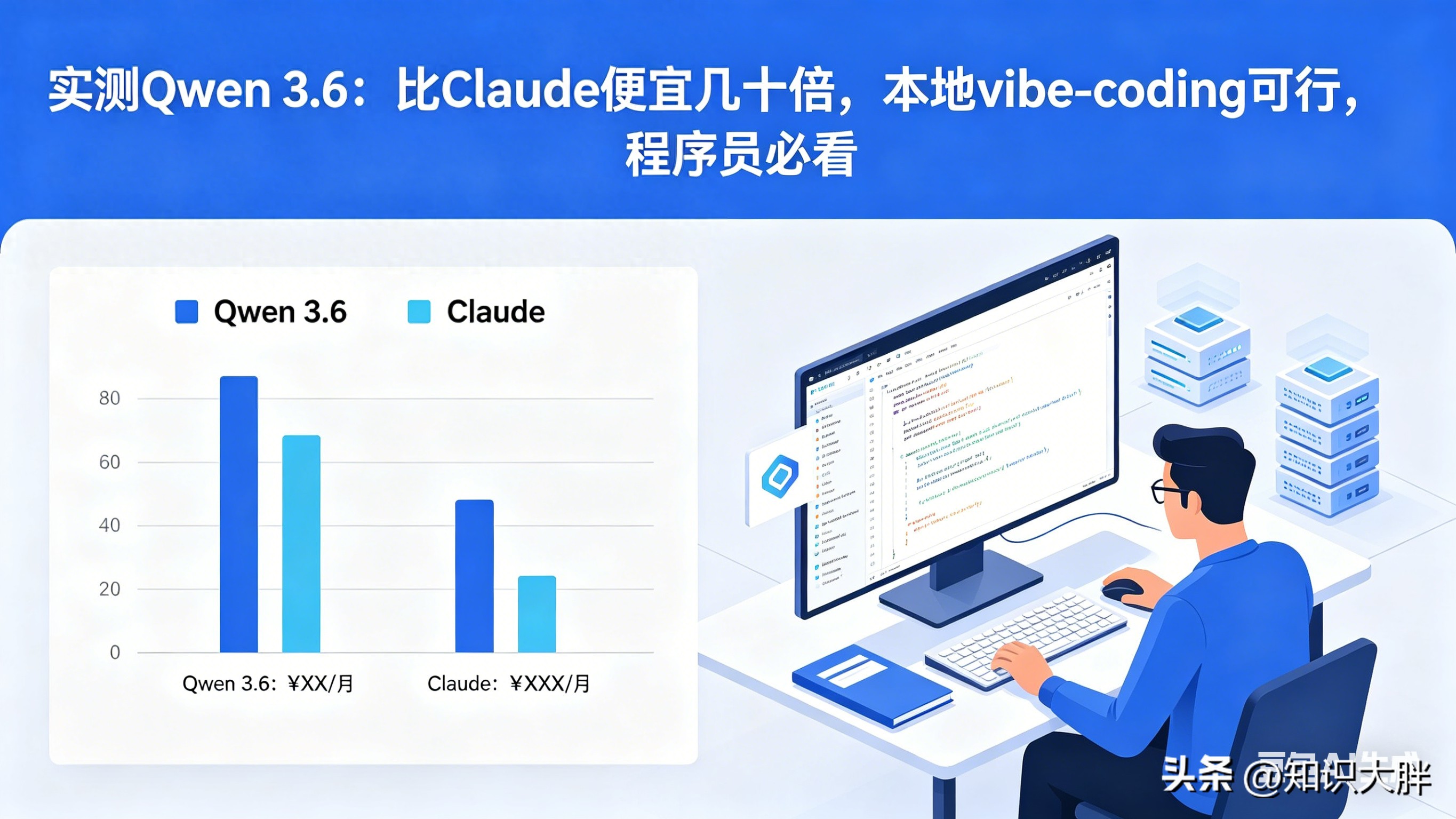
The combination of Qwen 3.6 and Unsloth has shattered this barrier. Testing data indicates that for the same 8-hour coding task, using the Claude API incurs approximately 975 yuan (based on an exchange rate of 1 USD to 6.8648 yuan), while local deployment of Qwen 3.6 costs less than 30 yuan (based on a 1kw/h electricity rate), reducing costs by over 97%. Even considering initial deployment expenses, frequent users can recoup their costs in under 30 days, making it highly cost-effective for regular coders.
Crucially, Qwen 3.6’s open-source nature allows more developers to access high-quality AI coding tools without worrying about licensing or fees. The optimization of the Unsloth framework also lowers the hardware barrier for local deployment, enabling large models to run smoothly on consumer-grade GPUs. This combination not only saves costs but also ensures code privacy, mitigating security risks associated with uploading core code to the cloud.
As open-source models continue to evolve, the performance of local models may eventually match or even surpass that of cloud APIs. This shift could transform coding practices from a reliance on cloud APIs to a primary focus on local models, achieving a truly efficient, low-cost, and secure coding experience.
Discussion: Would You Choose Local Deployment Over Claude?
After reviewing this testing, many programmers may feel tempted—saving on API costs while enjoying an efficient vibe-coding experience with Qwen 3.6 undoubtedly offers a new option.
Feel free to share your thoughts in the comments: Do you regularly use AI tools for coding? Are you accustomed to cloud APIs like Claude, or have you tried local model deployment? Do you think Qwen 3.6 can replace Claude as your primary coding tool? If given the choice, would you invest time in learning local deployment or continue paying for API usage?
Stay tuned for further updates on advanced deployment techniques and testing comparisons for Qwen 3.6, helping you easily master local AI coding while saving costs and boosting efficiency!
Comments
Discussion is powered by Giscus (GitHub Discussions). Add
repo,repoID,category, andcategoryIDunder[params.comments.giscus]inhugo.tomlusing the values from the Giscus setup tool.